Households spend 23.5% more in december and promotions play a bigger role in the christmas basket
Consumer habits at Christmas
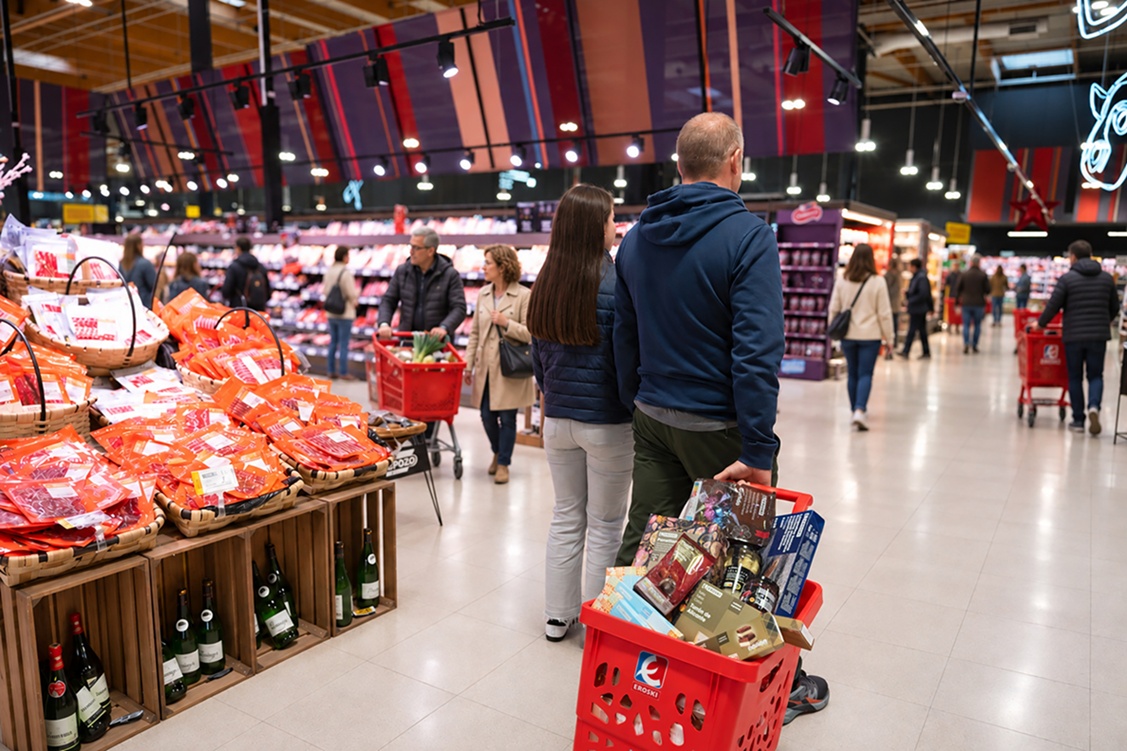
- In December, household spending is up 23.5% on the average for the rest of the year, with a 17.8% rise in value per basket, 2.3% more products and 16.1% more baskets per store per day.
- Christmas categories account for 47.2% of household spending in December, with Christmas products, chocolates, bulk frozen foods, sparkling wines and fish specialities especially prominent.
- EROSKI will invest €48 million in December to create savings opportunities during the Christmas campaign.
EROSKI has released the main findings of its analysis of consumer habits at Christmas, which shows how this time of year transforms the shopping behaviour of Spanish households. December accounts for approximately 10% of annual sales, both at EROSKI and across the market as a whole, and is marked by more frequent shopping and higher-value baskets.
EROSKI’s data for 2025 show that, in December, spending per household reaches an average of €544.9, which is 23.5% more than the average for the rest of the year. The average value per basket (+17.8%), the average number of units per basket (+2.3%) and the number of baskets per store per day (+16.1%) also rise.
Beatriz Santos, Commercial Director of EROSKI Group, said: “Christmas is still one of the most important times of the year for households, and it shows very clearly how the way they shop changes. We’re seeing more frequent shopping, higher-value baskets and a search for special products, but also close attention to savings and promotions. Our aim is to support families with a wide choice, combining quality, good prices, our suppliers’ brands, own-brand products, fresh produce and local products.”
The Christmas basket: more spending and a bigger share for special products
Categories linked to these celebrations account for 47.2% of total household spending in December. Among those gaining the most share are Christmas products, up 4.8 percentage points on their usual share; chocolates (+2.0 points); bulk frozen foods (+1.9); sparkling wines (+1.6); and frozen fish and shellfish (+1.1). Wine with a D.O. (Designation of Origin) (+0.9), fish specialities, the fish counter and whole hams (+0.8 for each category), and portioned pâtés (+0.7) also gain prominence.
The Christmas campaign also brings regional differences. Across the market as a whole, the value of sales in the Christmas period rises by 27.1% compared with the monthly average for the rest of the year. Extremadura (+34.8%), Castilla-La Mancha (+32.7%), Madrid (+32.4%) and the Basque Country (+32.2%) are among the regions where Christmas gives the biggest boost to commercial activity. Asturias, Galicia and Castile and León, meanwhile, stand out as the areas where specifically Christmas products carry the greatest relative weight in the basket compared with the national average.
All households increase their spending, though to different degrees
The rise in spending is seen across all household types, although retired people show the highest growth compared with the rest of the year (+30.4%), followed by families with older children (+24.7%), families with children of intermediate age (+20.5%) and young families (+19.2%).
In absolute terms, families with older children record the highest average spend in December, at €668.8. Christmas categories, for their part, carry the most weight among retired people, for whom they account for 51.3% of monthly spending.
Tradition, brands and convenience sit side by side in the basket
Christmas also changes what people choose to buy. Manufacturer brands increase their share across all household types in December, especially among young families and families without children. At the same time, own-brand products remain important as a way to save and as a route to offerings that combine quality and innovation, making for a basket in which both options meet different preferences and budgets.
Alongside traditional products, ready meals continue to gain ground: units sold rose 5.7% compared with December 2024 and 12.3% on the average for the rest of the year. Within this category, on-site cooking offerings grow 45% compared with December 2024, while Disfruta Cocinando is up 30.4% on the average for the rest of the year, reflecting the search for solutions that make it easier to prepare for the celebrations.
Promotions gain prominence and reinforce savings
Savings are another major factor shaping Christmas shopping. In December 2025, the share of sales on promotion reaches 38.6% across all categories and rises to 49.0% in Christmas-specific ones, the highest levels of the year.
Meanwhile, 26.3% of December shoppers belong to the customer segment particularly focused on using coupons, 8.2 percentage points more than during the rest of the year and 2.2 points more than in December 2024.
To respond to this focus on savings, EROSKI will invest €48 million in December to create savings opportunities during the Christmas campaign. The “Big Christmas Deals” will include 100 star products for Christmas tables, with a selection of fish, meat, tinned vegetables, nuts, cavas, wines and sweet treats at good prices. These will be joined by 2,000 products with 70% off the second unit, along with thousands of personalised savings coupons and surprise promotions.
Beatriz Santos added: “Christmas is a time when families want to enjoy themselves and, at the same time, manage their budget well. That’s why we’re stepping up savings opportunities and offering a wide range so that every household can build its basket to suit its needs, combining good prices, promotions, own-brand products and our suppliers’ brands.”
Innovation reinvents the Christmas classics
Innovation is also finding a place in traditional Christmas categories. In 2025, EROSKI introduced 133 innovative product lines in the sweet products section, 20.9% more than in 2024, with offerings that reinterpret traditional products, bring in trending flavours and create new gift experiences.
The analysis identifies four main areas of innovation: wellbeing and health, novelty and experience, convenience and indulgence. They allow the Christmas offering to be widened and respond to different occasions for consumption and different budgets.

